What the public thinks
In July 2026, YouGov asked 2,097 UK adults about the measures in the Media Freedom Act. Every one had far more support than opposition: at least three people in favour for every one against.
It isn’t one side of politics. We looked at 19 groups: Conservative, Green, Labour, Lib Dem and Reform UK voters, both sides of the Brexit vote, every age group, men and women, every type of occupation, and England, Scotland and Wales. In every group, on every question, more people backed the measure than opposed it.
% who support each measure, by group. In all 133 cases, more people support it than oppose it.
About the poll
YouGov surveyed 2,097 UK adults online on 6–7 July 2026, for the campaign when it was called the Media Sovereignty Act Campaign. Supporters paid for it through a Crowdfunder.
All figures, unless otherwise stated, are from YouGov Plc. Total sample size was 2,097 adults. Fieldwork was undertaken between 6th–7th July 2026. The survey was carried out online. The figures have been weighted and are representative of all UK adults (aged 18+).
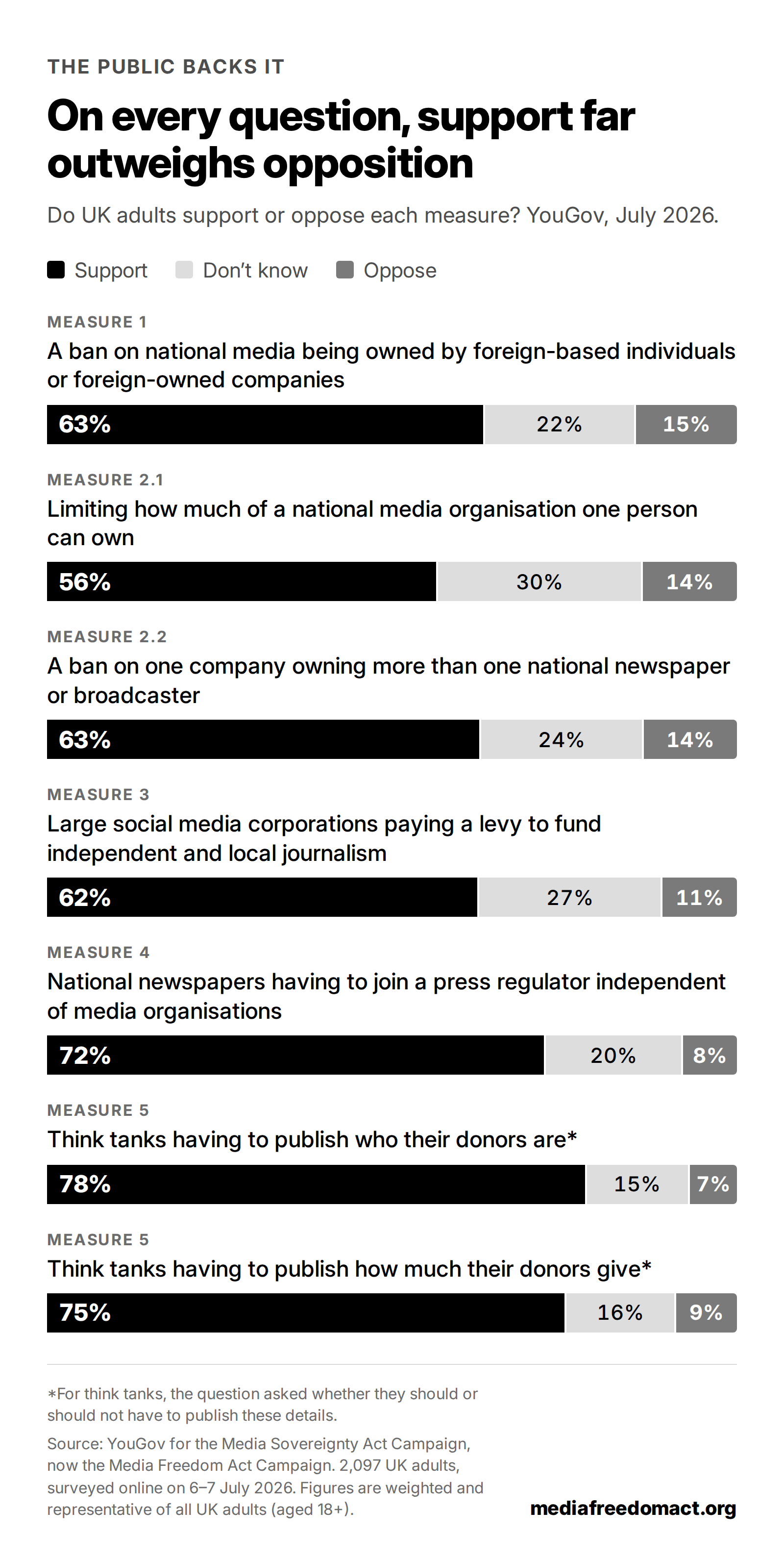
Support for each measure in the Act among all UK adults.
Measure 1: who owns our media
The measure: Media owners must be long-term UK residents.
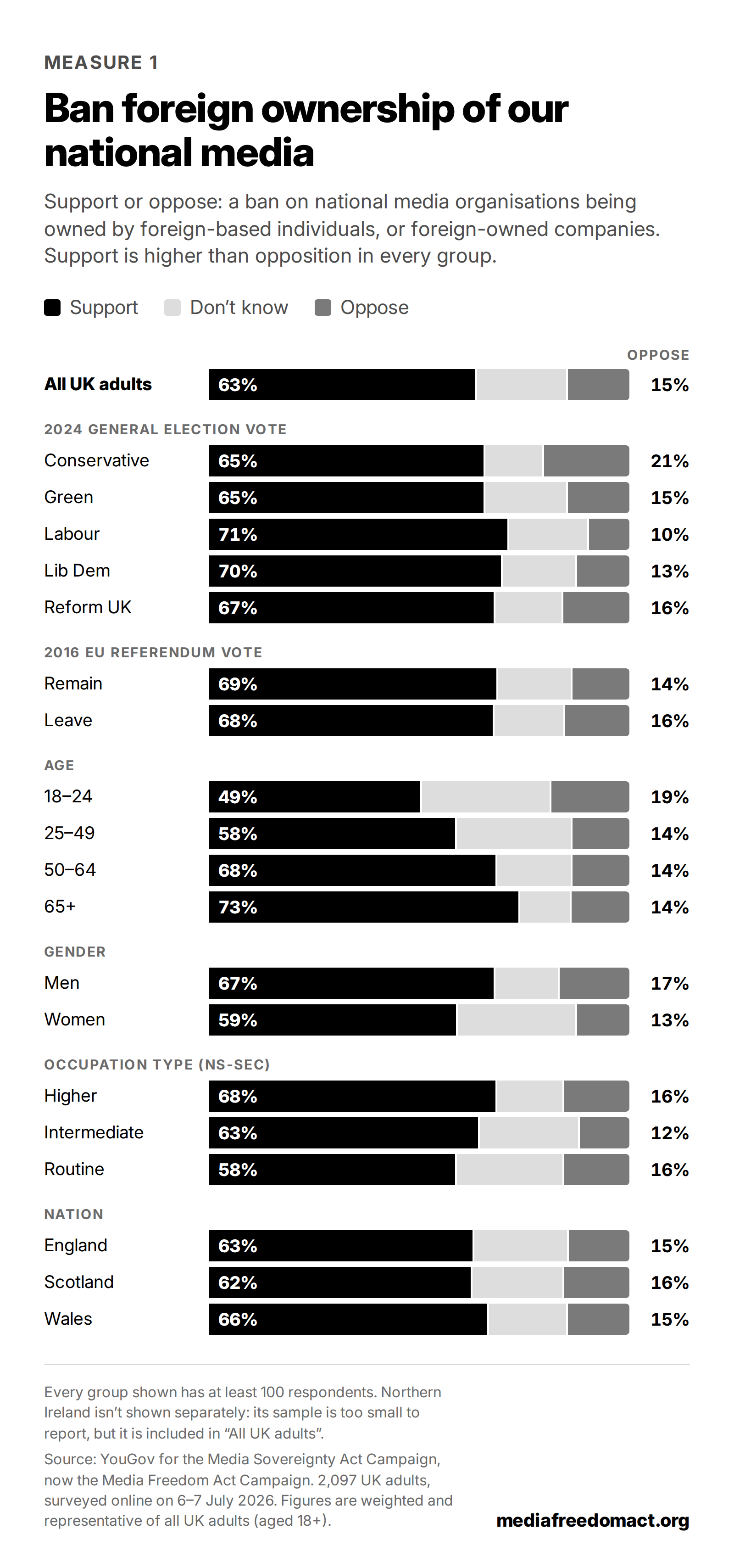
What we asked: Do you support or oppose “a ban on national media organisations being owned by foreign-based individuals, or foreign-owned companies”?
The result: 63% support, 15% oppose, 22% don’t know.
Every party: support runs from 65% of Conservative and Green voters to 71% of Labour voters, with Reform UK on 67% and Lib Dems on 70%.
Both sides of the Brexit vote: 69% of Remain voters and 68% of Leave voters.
It grows with age: 49% of 18–24s back it, rising to 73% of people aged 65 and over.
Measure 2.1: no media barons
The measure: Maximum ownership share of a national media outlet for one individual/family shall be 20%.
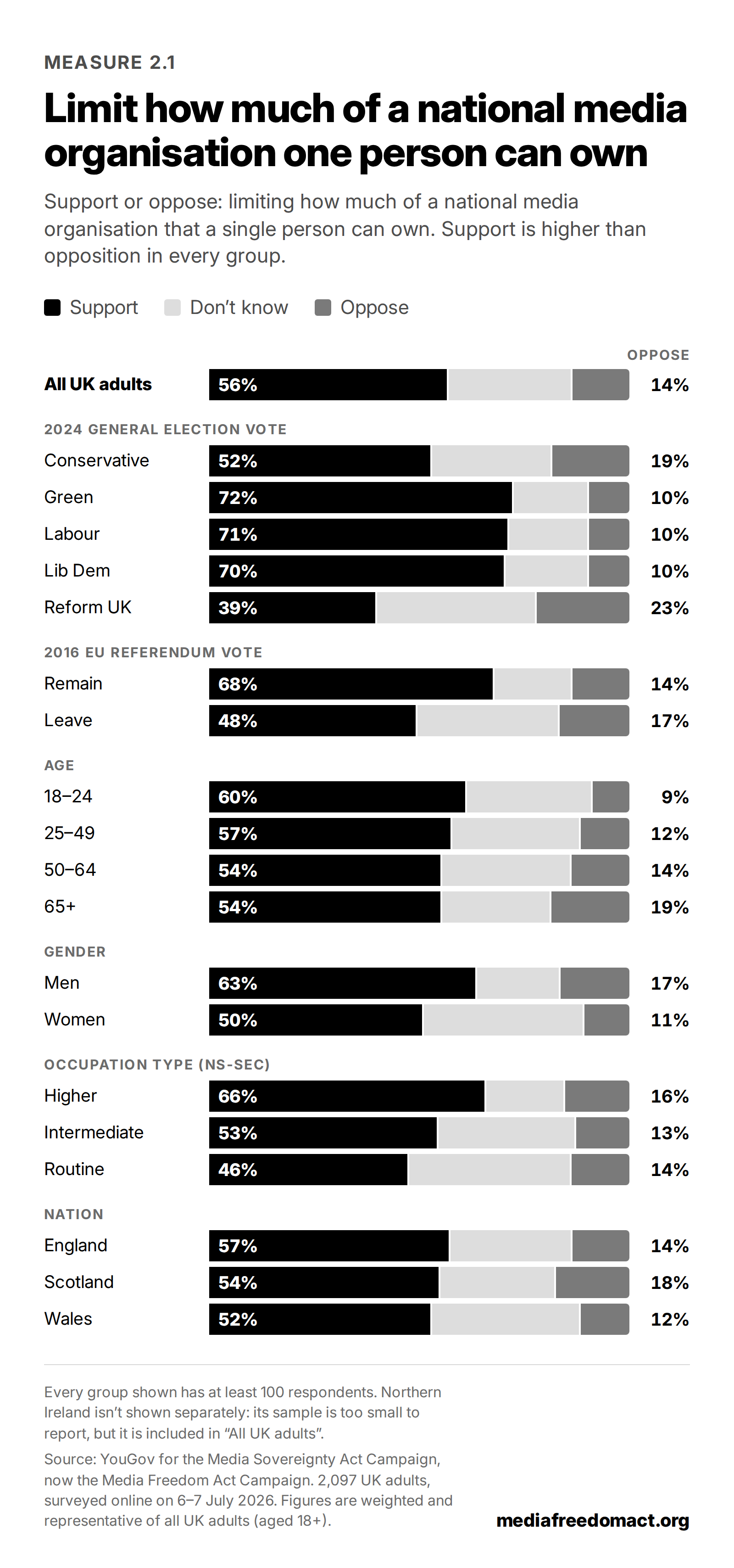
What we asked: Do you support or oppose “limiting how much of a national media organisation that a single person can own”?
The result: 56% support, 14% oppose, 30% don’t know. More people were unsure about this than about any other question.
Green, Labour and Lib Dem voters back it by 72%, 71% and 70%.
Conservative voters back it by 52% to 19%, and Reform UK voters by 39% to 23%, with 39% unsure.
Remain voters back it by 68% to 14%, and Leave voters by 48% to 17%.
Where should the limit be? We then asked the people who back a limit the most one person should be allowed to own. 49% said 20% or less and 43% said more. The Act’s 20% sits in the middle of what they told us.
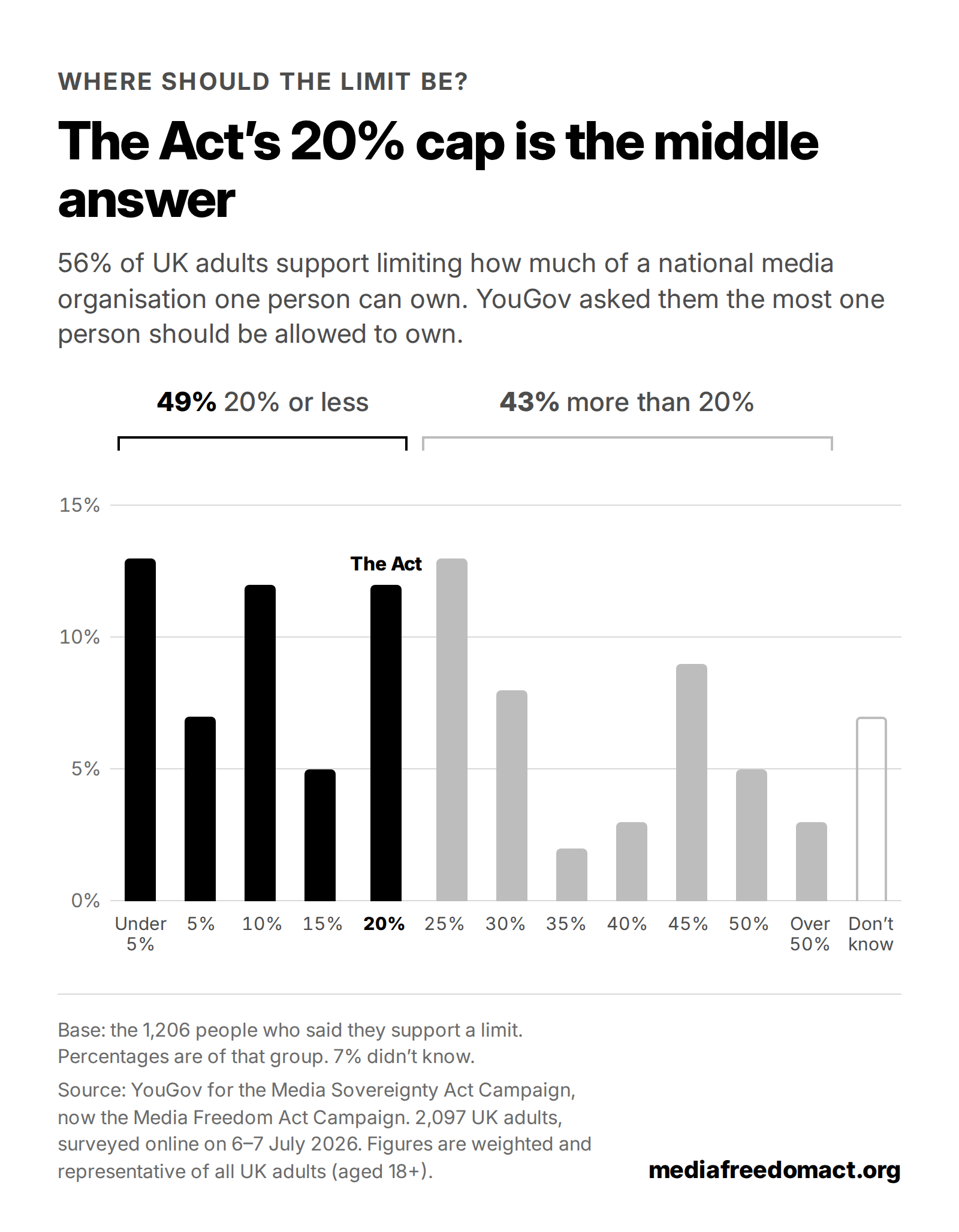
Asked of the 1,206 people who said they support a limit.
Measure 2.2: one company, one outlet
The measure: Commercial companies can only own one national media outlet.
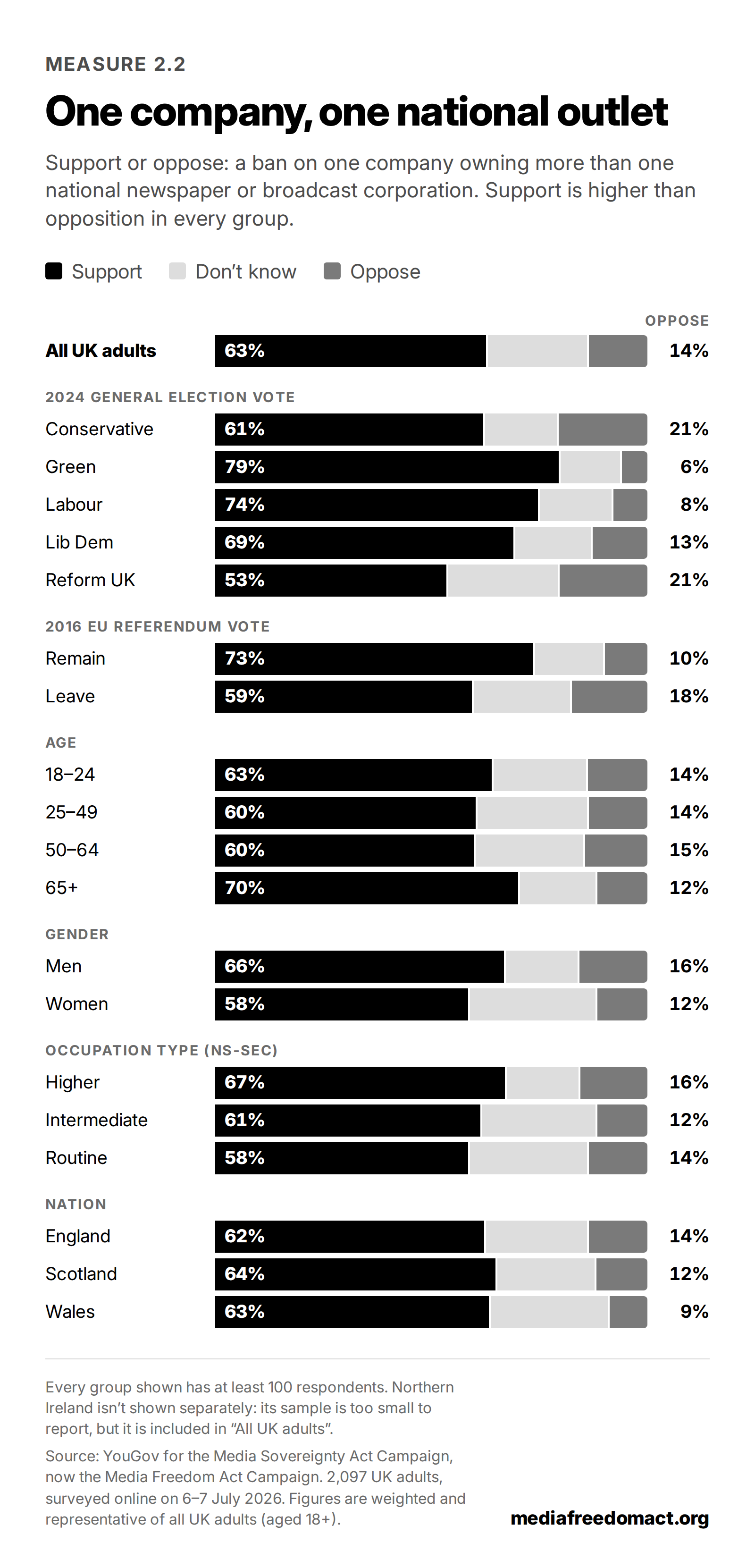
What we asked: Do you support or oppose “a ban on one company owning more than one national newspaper or broadcast corporation”?
The result: 63% support, 14% oppose, 24% don’t know.
Green voters back it most strongly, by 79% to 6%, followed by Labour (74%), Lib Dem (69%), Conservative (61%) and Reform UK (53%) voters.
Remain voters back it by 73% and Leave voters by 59%.
70% of people aged 65 and over back it.
Measure 3: make the social media giants pay for local news
The measure: Distributes media ownership across society with a levy on social media giants to fund local, independent and cooperatively owned media.
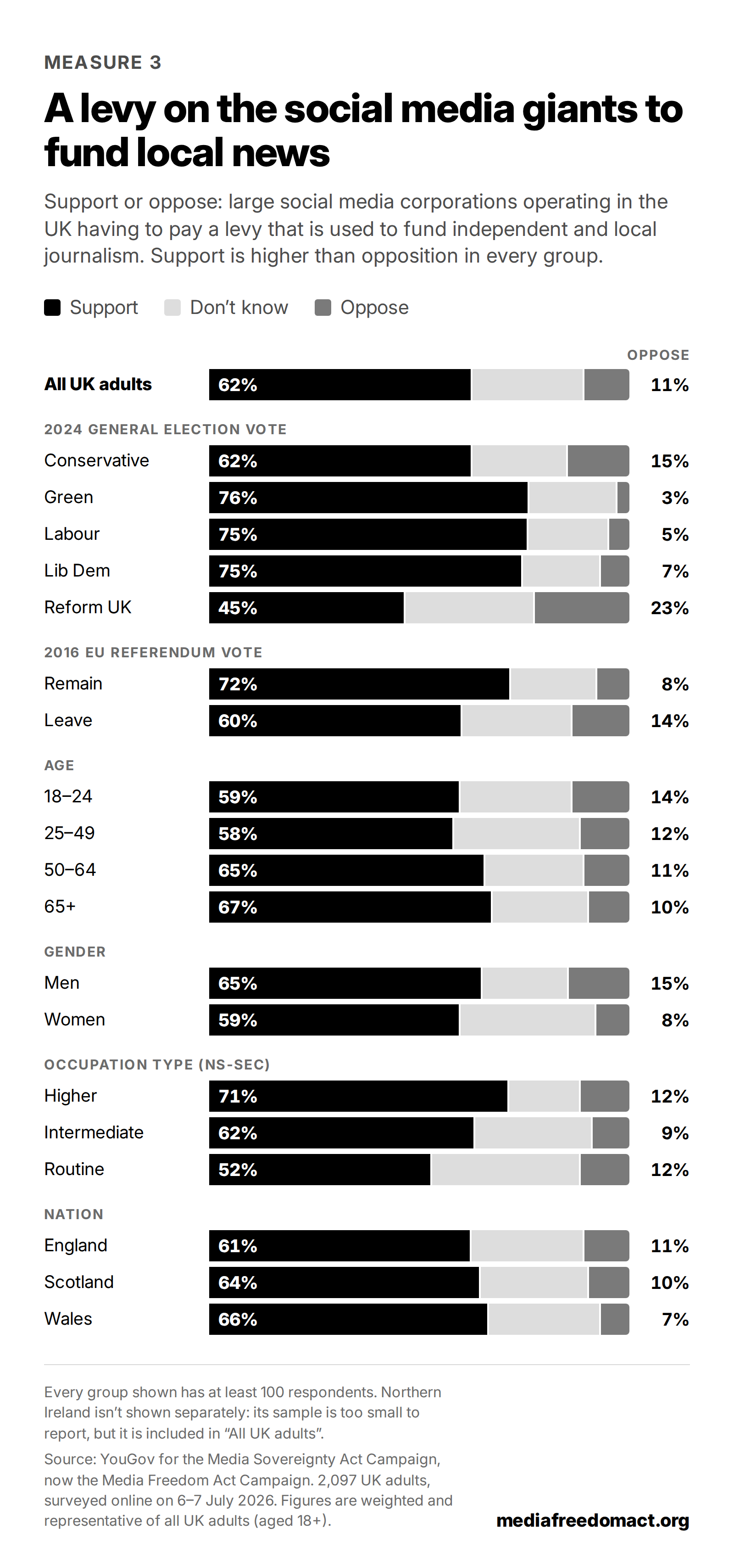
What we asked: Do you support or oppose “large social media corporations operating in the UK having to pay a levy that is used to fund independent and local journalism”?
The result: 62% support, 11% oppose, 27% don’t know.
Green voters back it by 76% to 3%, Labour voters by 75% to 5%, and Lib Dem voters by 75% to 7%.
Conservative voters back it by 62% to 15%, and Reform UK voters by 45% to 23%.
Remain voters back it by 72% and Leave voters by 60%.
Measure 4: somewhere independent to complain
The measure: UK media must be members of a press-abuse complaints authority independent of government and owners.
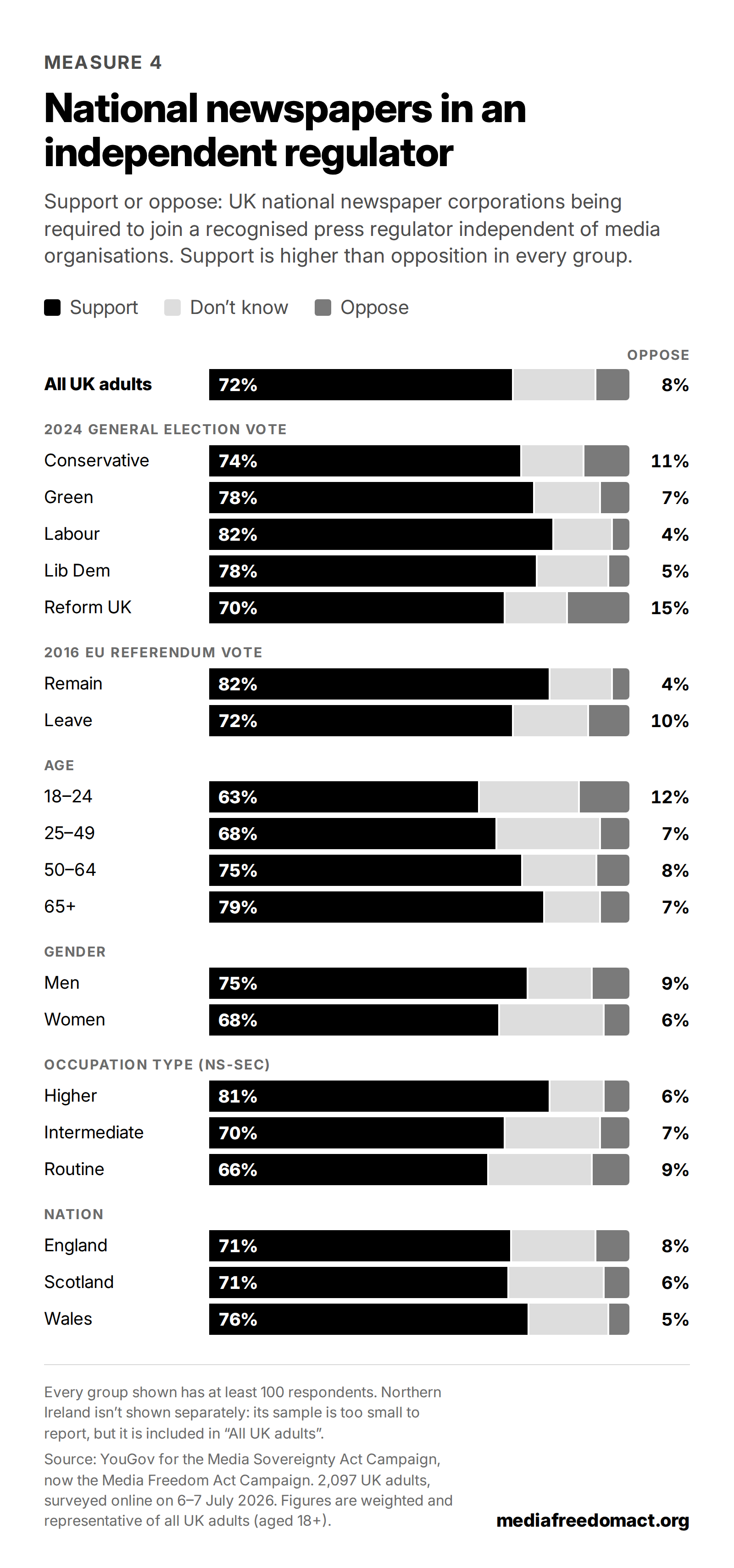
What we asked: Do you support or oppose “UK national newspaper corporations being required to join a recognised press regulator independent of media organisations”?
The result: 72% support, 8% oppose, 20% don’t know.
Every party: Labour voters back it by 82%, Green and Lib Dem voters by 78%, Conservative voters by 74% and Reform UK voters by 70%.
Remain voters back it by 82% to 4%, and Leave voters by 72% to 10%.
79% of people aged 65 and over back it.
Measure 5: who funds the think tanks
The measure: Requires think tanks covered by the media to disclose donations in real time.
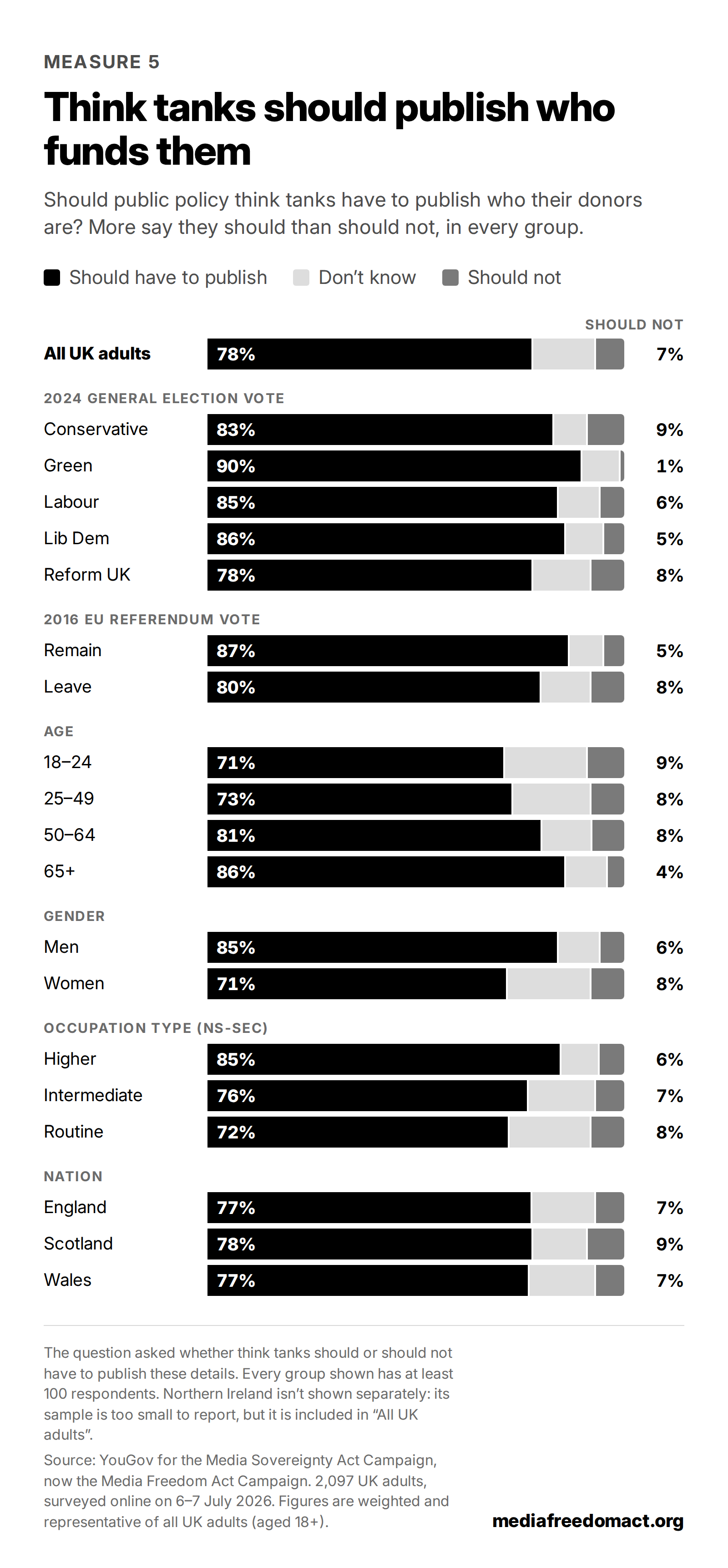
What we asked: Should public policy think tanks have to publish “who their donors are”, and “how much their donors give”?
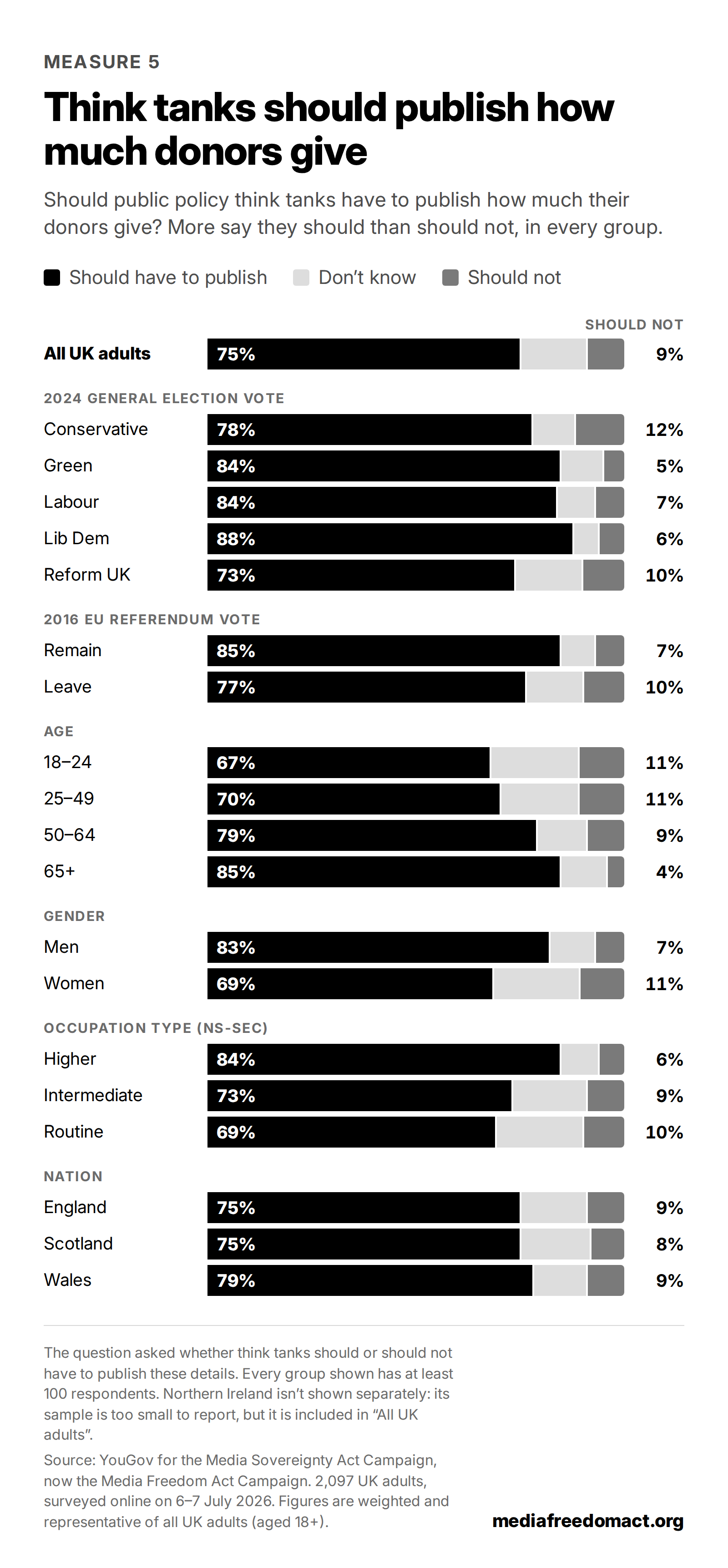
The result: 78% say think tanks should have to publish who their donors are, and 7% say they shouldn’t: more than ten to one. 75% say they should publish how much donors give, and 9% say they shouldn’t.
Who funds them: 90% of Green voters, 86% of Lib Dem voters, 85% of Labour voters, 83% of Conservative voters and 78% of Reform UK voters.
How much: 88% of Lib Dem voters, 84% of Green and Labour voters, 78% of Conservative voters and 73% of Reform UK voters.
Remain voters say think tanks should publish who funds them by 87% to 5%, and Leave voters by 80% to 8%.
Asked of the 1,206 people who said they support a limit.
What the poll didn’t ask
We quote every figure for the question it answers, and some parts of the Act weren’t asked about:
Real time. The poll asked whether think tanks should publish their donors, not how quickly.
Government. The regulator question was about independence from media organisations. It didn’t mention government, or powers to punish.
Residence. The poll asked about foreign-based owners. The Act’s test is long-term UK residence: where you live, not your nationality.
Northern Ireland. Northern Ireland’s sample was too small to report on its own, though it is included in every UK-wide figure.
Using these figures
Journalists, campaigners and supporters are welcome to use these figures and graphics. Please quote each figure for the question it answers, and credit “YouGov for the Media Freedom Act Campaign (then the Media Sovereignty Act Campaign), 6–7 July 2026”. For anything else, see our press page.
The public is already with us
What’s missing is pressure where the decisions get made. Help turn this support into law.