Green Party votes for social media levy and 20% cap on press ownership
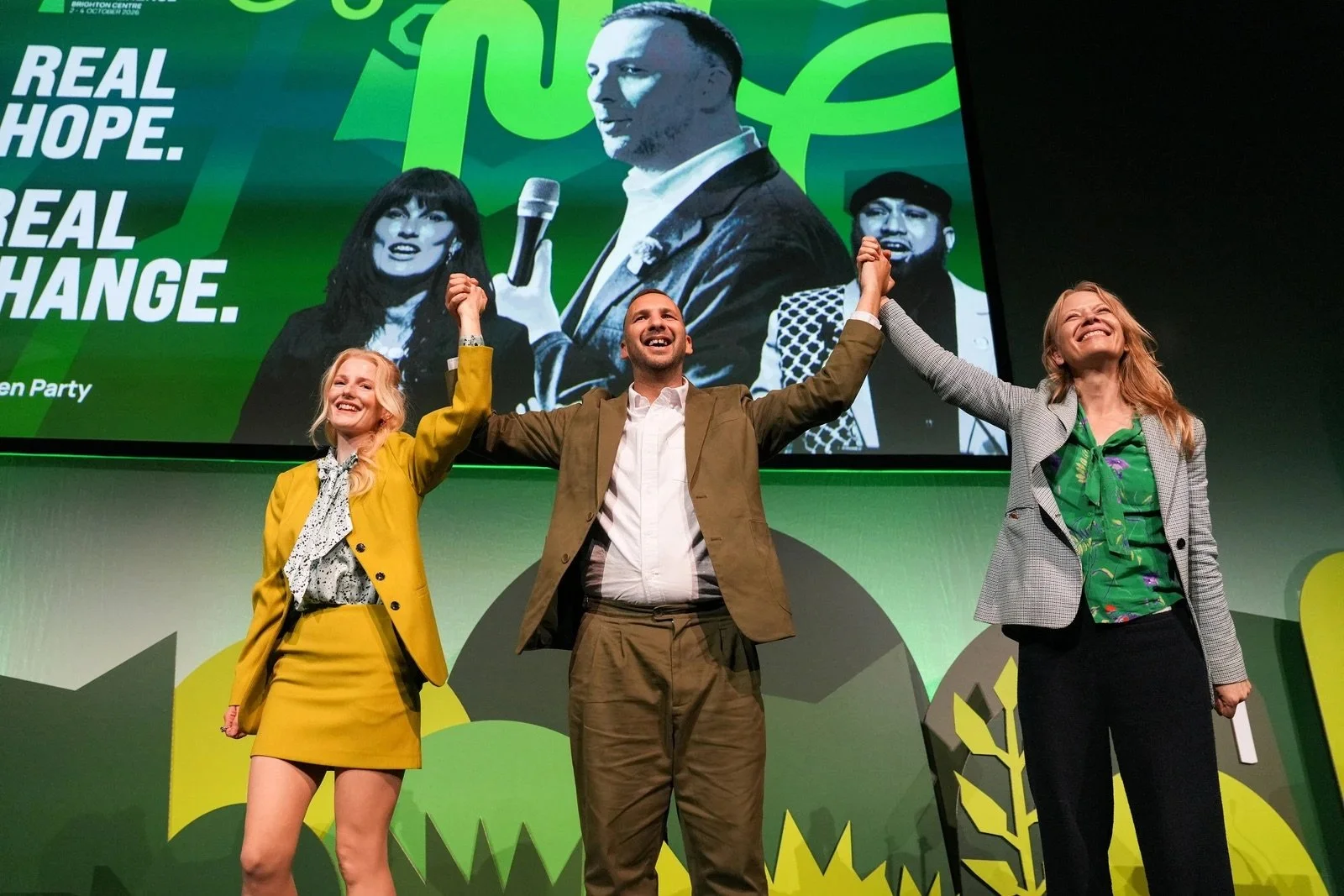
[Left to right] Hannah Spencer MP, Green Party leader Zack Polanski and Sîan Berry MP at the Green Party conference in Brighton, 2 October 2026. (Reuters)
FOR IMMEDIATE RELEASE: 6 October 2026
The Green Party of England and Wales has voted overwhelmingly for a new media policy. It would cap how much of the press any one company can own, make large social media corporations pay a levy to fund local journalism, and bring the press under independent regulation.
The party’s Culture, Media and Sport policy (B04) was passed at its autumn conference in Brighton on Saturday 3 October. It includes four of the five measures in the Media Freedom Act, which the Media Freedom Act Campaign is asking every party to adopt. The party’s policy working group consulted the campaign while drafting the policy and cites the campaign’s draft Act in its background paper.
The new policy commits the party to:
limiting ownership of the press to 20% for any one company, and requiring companies with larger market shares to sell, with a presumption against owning outlets across different types of media;
a levy on large international social media corporations operating in the UK, to fund local and independent journalism;
independent, statutory regulation of the media, with regulators independent of industry and government that can investigate complaints and act on their findings;
requiring media organisations to platform only think tanks that are open about their funding;
co-operative and community ownership as key drivers of democracy in the media.
Donnachadh McCarthy, co-director of the Media Freedom Act Campaign, said:
“Britain will not have a free and fair democracy until we end its capture by the 0.0001% who own our media. Congratulations to the Green Party on a new media policy that would begin to free our democracy from the billionaire-owned press. It is time for every other party to do the same.”
The policy doesn’t yet cover where media owners live. That is the Act’s first measure: media owners must be long-term UK residents. The working group told members it had left foreign ownership open for later policy development, and the campaign will continue to work with the party on it.
The measures have wide public support. In a YouGov poll for the campaign in July, 62% of UK adults backed a levy on large social media corporations to fund independent and local journalism, with 11% opposed. 72% wanted national newspapers to join a regulator independent of media organisations, with 8% opposed. Among Green voters, the levy was backed by 76% to 3%.
Caspar Hughes, co-director of the Media Freedom Act Campaign, said:
“Ending self-regulation by the billionaire owners of the Sun, the Mail and the rest would be a huge step for the victims of press abuse. And a social media levy would put money back into local newspapers, which are vital for holding local councils to account.”
ENDS
Press contact: Donnachadh McCarthy, co-director, 07947 884299, dmc@mediasovereignty.org
Notes to editors
1. The Media Freedom Act Campaign is campaigning for a UK Media Freedom Act to free British democracy from capture by billionaire-owned media. It was called the Media Sovereignty Act Campaign until September 2026. mediafreedomact.org
The Act has five measures:
Media owners must be legal UK residents.
Frees media ownership from domination by billionaires and corporations.
i. Maximum ownership share of a national media outlet for one individual/family shall be 20%.
ii. Commercial companies can only own one national media outlet.
Distributes media ownership across society, with a levy on social media billionaires to fund local, independent, and cooperatively owned media.
UK media must be members of a press-abuse complaints authority independent of government and owners.
Requires think tanks covered by the media to disclose donations in real time.
2. The Green Party policy. B04, the Culture, Media and Sport Voting Paper, was passed at the Green Party of England and Wales’s Autumn Conference in Brighton on 3 October 2026. Relevant extracts are in note 4.
3. Polling. YouGov asked UK adults whether they supported or opposed each measure (support / oppose, %):
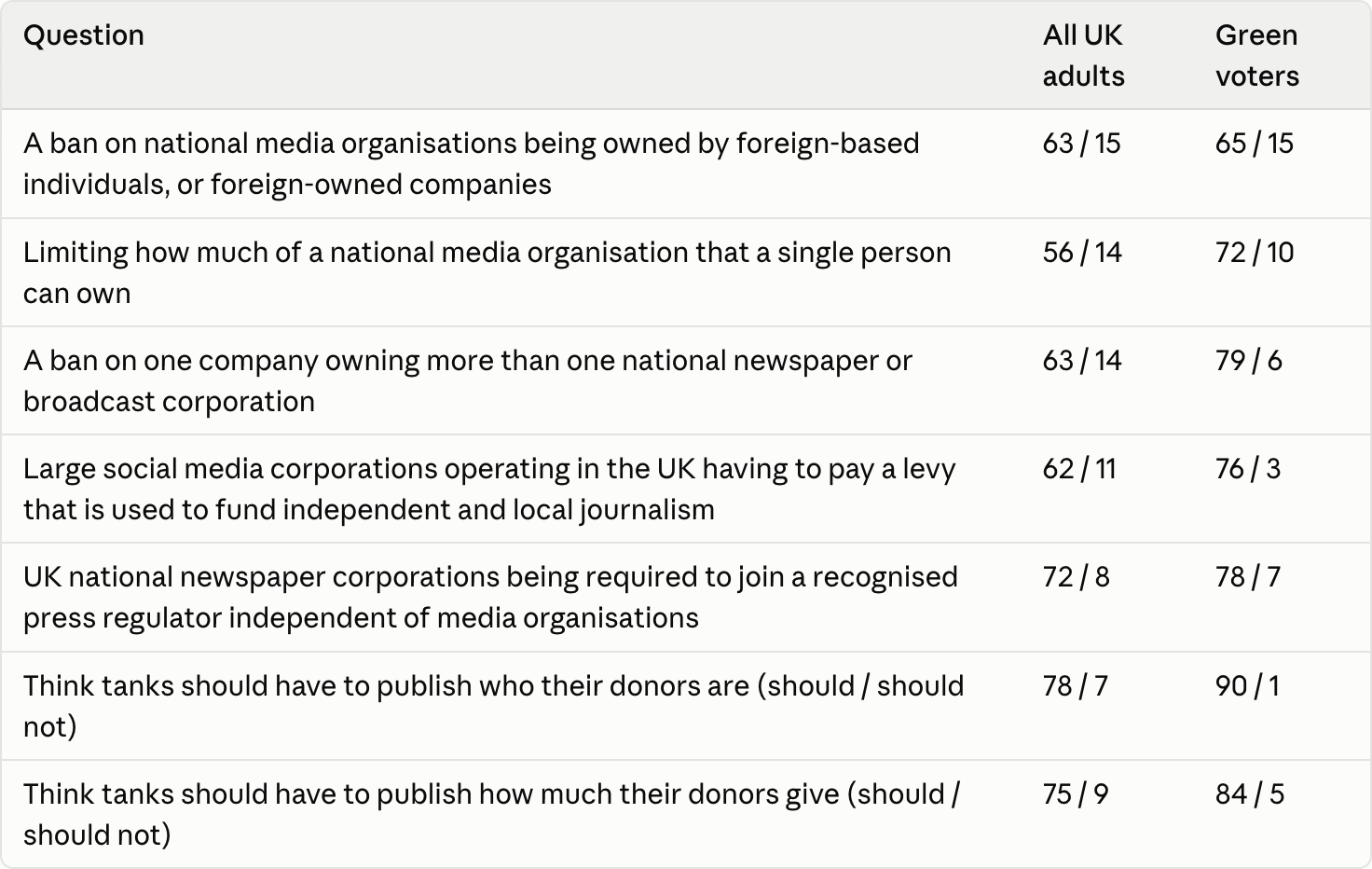
Support outweighs opposition on every question among Conservative, Green, Labour, Liberal Democrat and Reform UK voters.
All figures, unless otherwise stated, are from YouGov Plc. Total sample size was 2,097 adults. Fieldwork was undertaken between 6th–7th July 2026. The survey was carried out online. The figures have been weighted and are representative of all UK adults (aged 18+).
4. Extracts from B04 as passed:
CMS110 Regulation
The Green Party will seek for independent, statutory regulation of all Cultural, Sporting and Media activity.CMS112 Democracy
Co-operative models of ownership and working, youth-led and inter-generational initiatives and community-led decision-making will be key drivers for promoting democratic participation in Cultural, Media and Sporting activities. These democratic models may be mandatory for larger (financial/employment) platforms and organisations.CMS120 We will mandate all regulatory bodies and frameworks to:
Ensure their members and chairs are democratically, inclusively and fairly elected, and independent from industry and Government.
Investigate complaints and have legal authority to act effectively on the findings of investigations.
[…]CMS302 Ownership of the means of content production and distribution of all media is an important concern for social cohesion, diversity of opinion in public debate and public health.
CMS315 The Green Party will prevent our media landscapes from being dominated by minorities of political and private influence, by:
Opposing monopolisation of the press (see EC651).
Limiting ownership of the press to 20% maximum for any one company and requiring divestment for companies with larger market shares.
[…]Requiring media organisations to only platform the work of think tanks that are transparent about their funding.
CMS316 We will ensure public access to a broad spectrum of news and views, by:
Encouraging local ownership and editorial control of titles particular to specific communities, cities and regions.
[…]We will increase funding available for local and independent journalism, local news forums (CMS318) and digital public service media platforms and technologies (CMS328) by introducing a levy on large international social media corporations operating in the UK.
CMS338 Commercial media organisations will be regulated such that there is a presumption against aggregation of ownership both within and across media types.